

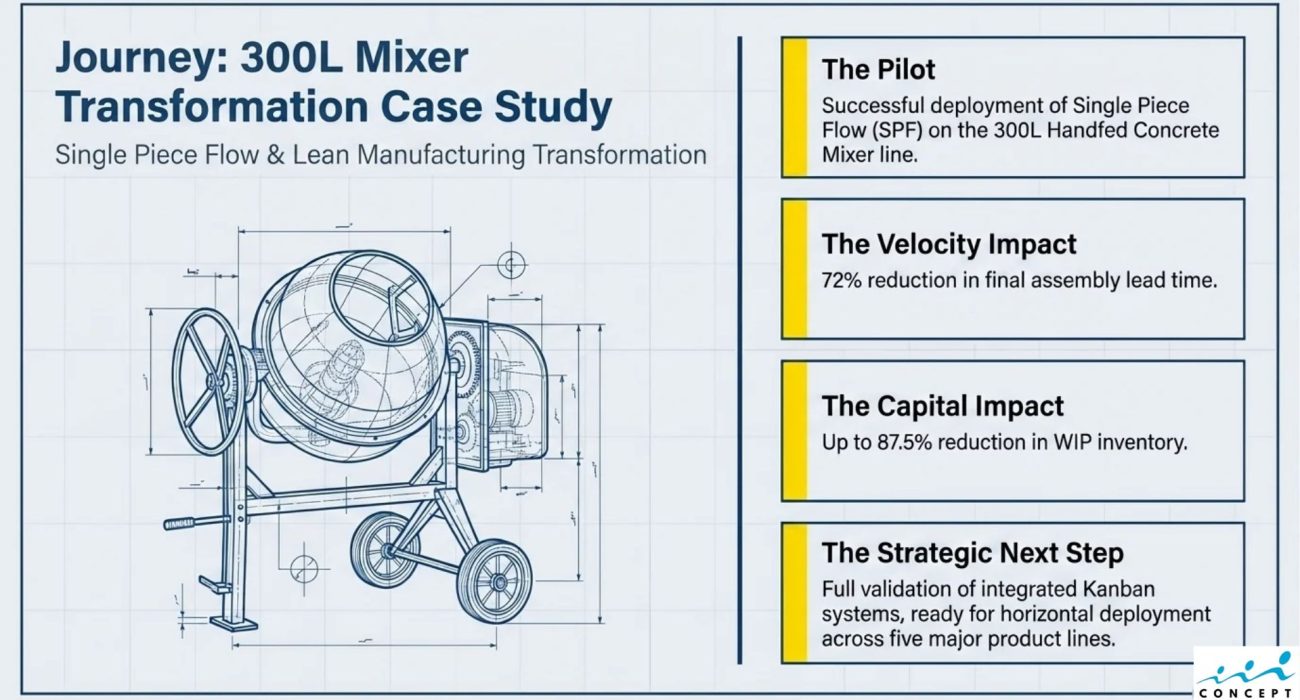
How a 300L Mixer Line Cut Assembly Lead Time by 72%
What if a production line could move faster without simply asking people to work harder?
In the transformation of a 300L mixer assembly line, the team set out to improve how work moved through production. Their approach focused on rethinking the flow—not just speeding up individual tasks.
The results were significant: assembly lead time fell from 654 minutes to 180 minutes, a 72% reduction. Work-in-process inventory also dropped by as much as 87.5% in key assemblies.
The numbers are impressive, but they raise an even more interesting question: what changed on the shop floor to make this possible?
The challenge behind the numbers
In a batch-based production system, components often move in groups from one operation to the next. While each task may appear productive, work can spend considerable time waiting between stages. Parts accumulate, operators may need to search or move materials, and delays in one area can affect the entire line.
Over time, these queues and handoffs become part of the routine. The process continues, but it can be difficult to see where time is being lost—or how much inventory is sitting between operations.
For the mixer line, the opportunity was to improve the overall flow of production. Instead of treating each workstation as a separate step, the transformation looked at how tasks, materials and operators could work together more smoothly.
Moving toward single-piece flow
A key part of the approach was shifting from batch production toward single-piece flow. The aim was to help work progress through the assembly process in a more continuous way, rather than waiting for larger batches to build up.
That required more than moving equipment around. The team redesigned workstations, clarified task sequences and introduced visual standards to support consistent work. The future-state layout grouped activities to create a more logical flow and make handoffs between stages easier to manage.
The transformation also emphasized visual management. When work instructions, material needs and production signals are clear, operators can spend less time interpreting what to do next—and teams can spot issues sooner. Standardized work helps make expectations visible and repeatable, while a better-designed workspace can reduce unnecessary movement and confusion.
Connecting production with demand
The team also introduced a pull-based replenishment approach supported by Kanban. Rather than pushing large quantities of materials into production in advance, a pull system uses visible signals to guide replenishment based on what the process needs.
When designed well, this can help reduce excess inventory and make shortages or disruptions easier to notice. It also creates a clearer connection between production activity and material supply.
Kanban was one part of a broader operating model. Its impact depended on how it worked alongside the redesigned flow, standardized tasks and visual controls. Together, these elements were intended to make production easier to coordinate and less reliant on buffers of waiting work.
The impact
| Measure | Before | After |
|---|---|---|
| Total assembly lead time | 654 min | 180 min (72% faster) |
| WIP inventory – yoke assembly | Baseline | 87.5% lower |
| WIP inventory – engine cabin | Baseline | 75% lower |
| WIP inventory – base, angle and drum | Baseline | 50% lower |
These improvements can have effects beyond the production line. Lower work-in-process inventory means less capital tied up in parts waiting to be assembled. A smoother flow can make delays more visible, while clearer standards can support consistency across workstations.
The goal was not simply to produce faster. It was to create a more organized and predictable way of working—one that supports better flow, visibility and control.
A pilot with wider potential
The 300L mixer transformation was presented as a pilot for the broader Parivartan methodology. Its lessons may offer a starting point for other production environments, though each line has its own constraints and requires an approach suited to its products, demand and processes.
The headline results tell us what improved. The full case study reveals more about how: the flow redesign, shop-floor practices and decisions that helped connect the changes into one system.
Get the full case study
Curious about the details? Request the full Parivartan 300L Mixer case study to explore the transformation and its practical lessons.
Figures are from the Parivartan 300L Mixer Transformation presentation. Results may vary in other manufacturing environments.
Request for Full Case Study.
Get access to the architecture diagrams and implementation blueprints.
Request Received Successfully!
Thank you for your interest. Our team will manually review your details and email the PPT presentation to your business address shortly.