

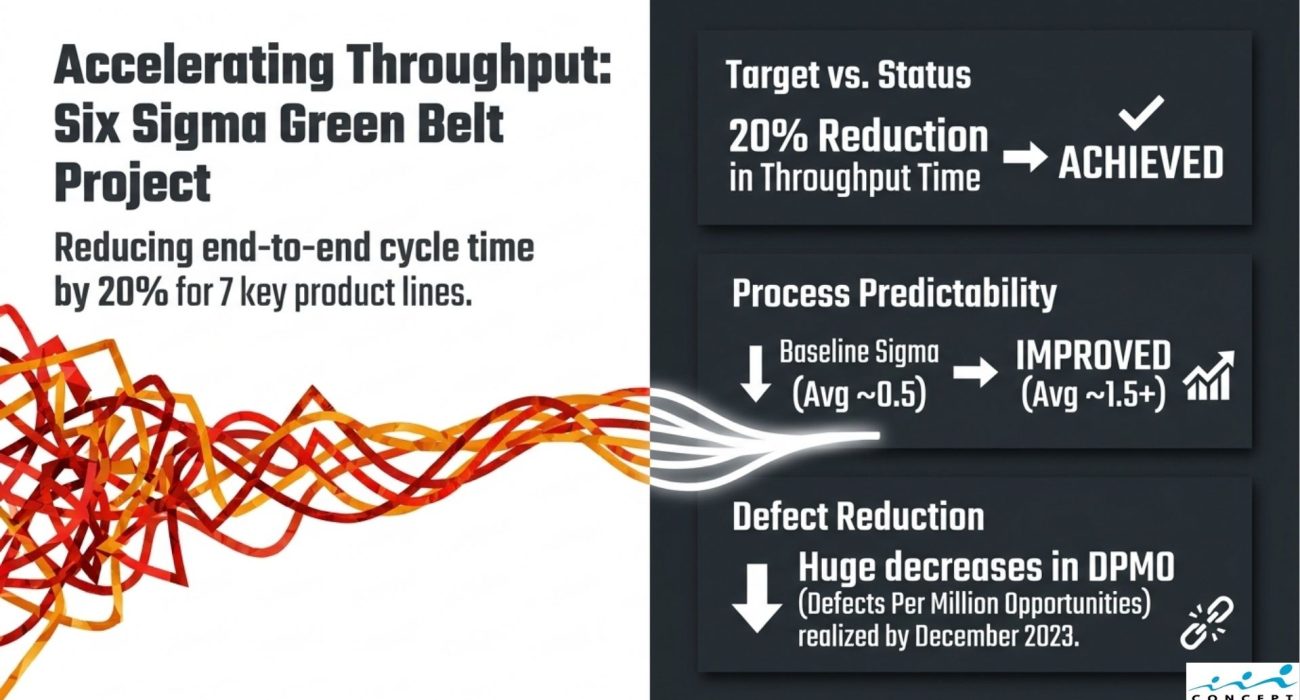
In today’s competitive manufacturing environment, reducing lead time while maintaining quality is essential for operational excellence. This Six Sigma Green Belt Project demonstrates how a structured improvement approach helped achieve a 20% reduction in end-to-end throughput time across seven key product lines, resulting in faster delivery, improved process stability, and reduced defects.
The Challenge
The organization faced long and inconsistent throughput times that affected production efficiency and customer responsiveness. Process variations, bottlenecks, and quality issues were creating delays across multiple product lines, making it difficult to meet operational targets.
The Six Sigma Approach
Using the DMAIC (Define, Measure, Analyze, Improve, Control) methodology, the project team identified key process inefficiencies and sources of variation. Detailed data analysis helped uncover non-value-added activities, workflow bottlenecks, and quality-related delays that were impacting overall throughput.
Improvement initiatives focused on streamlining workflows, reducing variation, eliminating waste, and standardizing critical process steps.
Results Achieved
1. 20% Reduction in Throughput Time
The project successfully achieved its primary objective by reducing end-to-end cycle time by 20% across seven major product lines. This enabled faster production flow and improved responsiveness to customer demand.
2. Improved Process Predictability
Process capability and predictability improved significantly. The baseline sigma level, which averaged around 0.5, increased to approximately 1.5+, indicating a more stable and consistent process with reduced variation.
3. Significant Defect Reduction
The project also delivered substantial reductions in DPMO (Defects Per Million Opportunities), improving product quality and reducing the costs associated with rework, scrap, and customer complaints.
Key Business Benefits
- Faster order fulfillment and delivery performance
- Improved production efficiency and capacity utilization
- Reduced process variation and operational uncertainty
- Lower defect rates and quality costs
- Enhanced customer satisfaction through reliable performance
Conclusion
This Six Sigma Green Belt Project highlights how data-driven problem-solving can deliver measurable business results. By focusing on throughput improvement, process predictability, and defect reduction, the organization achieved sustainable operational gains while strengthening its competitive position.
The case demonstrates that even modest improvements in cycle time and variation can create significant business impact when applied across multiple product lines and critical processes.