

Executive Summary
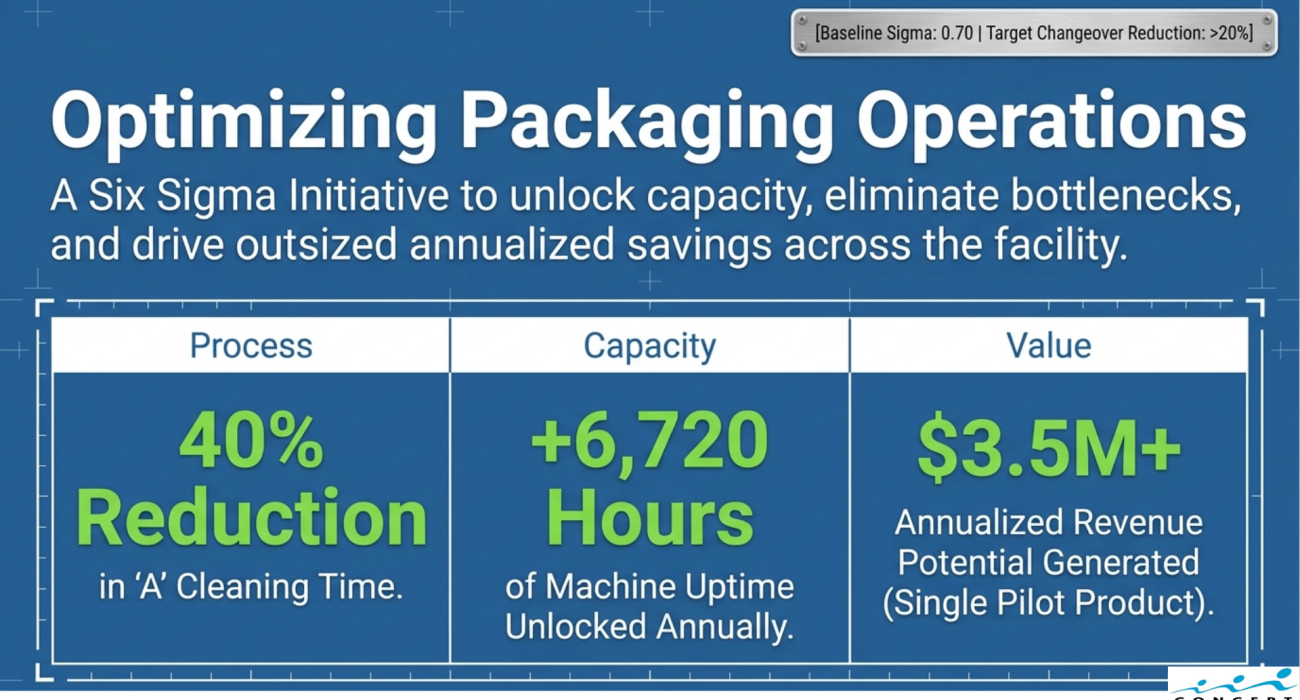
In the high-stakes world of pharmaceutical packaging, equipment downtime is a direct drain on profitability. This case study details a Green Belt Six Sigma project that successfully reduced packaging changeover time by over 40%, unlocking $3.5 million in annual potential revenue and gaining thousands of hours in additional machine capacity.
The Challenge: The High Cost of Downtime
A major pharmaceutical packaging facility was struggling with changeover times ranging from 3 to 5 hours. These delays were identified as a critical business risk, leading to:
- Significant backorder penalties and lost revenue potential.
- Reduced overall efficiency in the packaging process.
- Increased non-value-added manpower resource time.
The primary objective was to achieve a minimum 20% reduction in changeover time to improve uptime and productivity.
The Strategy: Data-Driven DMAIC Methodology
Using the DMAIC (Define, Measure, Analyze, Improve, Control) framework, the project team analyzed the bottle packaging lines. A Pareto analysis identified that “A Cleaning” was the single largest bottleneck, accounting for 63.2% of the total process time.
Key Insights from the Analysis Phase:
- Inefficient Labor Allocation: Previously, two operators were tied up washing parts, leaving only three operators to clean the production room.
- Equipment Design Flaws: A “Gemba Walk” identified “hidden spots”—such as open mounting holes and gaps in conveyor end caps—where tablets could become lodged, leading to repeated QA cleaning failures.
- Tooling Constraints: The lack of a secondary set of cleaning parts meant the line remained idle while the primary set was being washed.
The Solution: Lean Optimization & Physical Innovation
The team implemented a multi-faceted improvement strategy:
- SMED (Single-Minute Exchange of Die) Principles: The facility procured a second set of cleaning parts (slat machine parts, etc.), enabling “offline cleaning”. This allowed the next batch to start immediately while the previous parts were washed separately.
- Optimized Labor Distribution: With the second set of parts available, all five operators were reallocated to room cleaning, significantly increasing efficiency.
- Engineering Modifications: To prevent QA delays, the team fabricated plates to cover motor shafts, repaired conveyor end caps, and installed plugs in equipment feet to eliminate tablet “hiding spots”.
- Standardized Workflow: A new, optimized cleaning order was established with specific time durations for every activity on the line.
The Results: Impact on the Bottom Line
The pilot study on the packaging line yielded extraordinary results:
- Time Reduction: Changeover time dropped from an average of 5.26 hours to just 3 hours—a 43% improvement.
- Productivity Gain: Each cleaning gained 2 hours of additional production time, equivalent to 4,200 additional bottles per run.
- Annual Financial Impact:
- $3,558,576 in annual potential revenue for a single high-demand product line.
- $201,600 in direct manpower cost savings across 7 packaging lines.
- 6,720 hours of additional packaging machine capacity gained annually.
Quality & Sigma Level: The process Sigma level improved from 0.70 to 1.25, reflecting a significant reduction in process defects and cleaning failures
Are you looking to liberate hidden capacity in your production lines? Standardization isn’t just about speed—it’s about predictable, scalable profitability.