

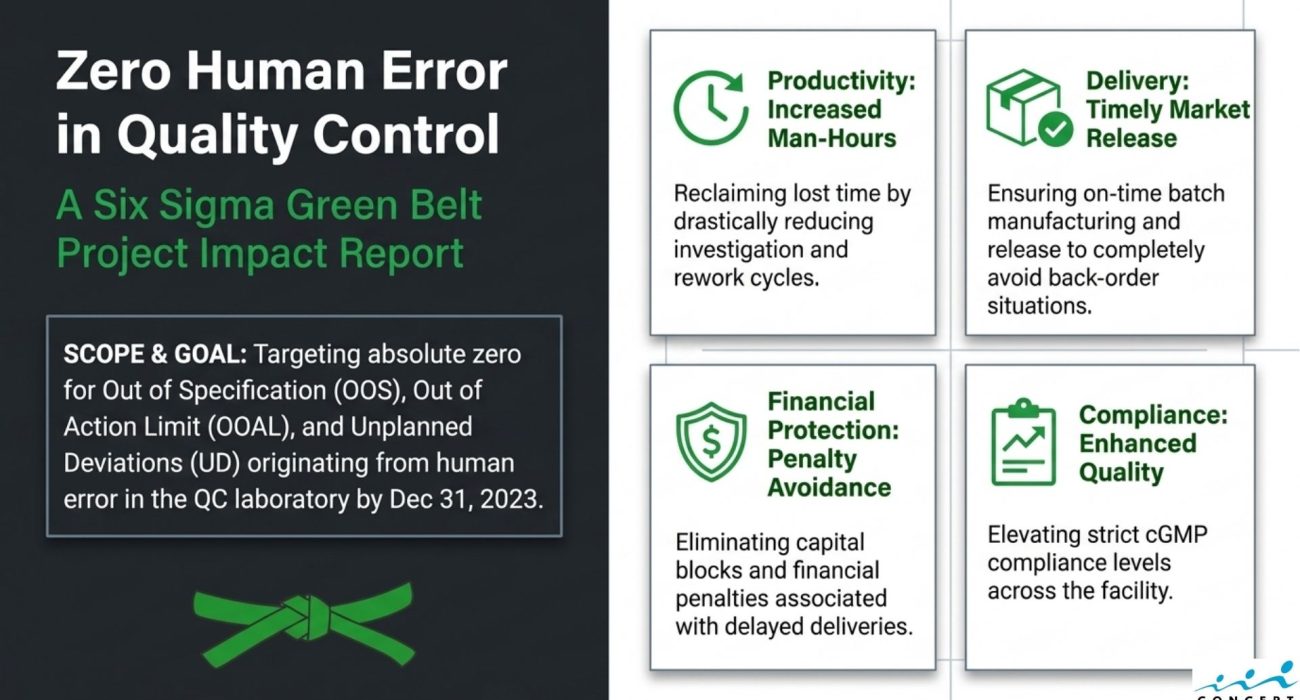
Achieving Zero Human Error in Quality Control is a major challenge in pharmaceutical and manufacturing industries. Even small mistakes in a Quality Control (QC) laboratory can result in Out of Specification (OOS), Out of Action Limit (OOAL), delayed product release, compliance risks, and financial losses.
This Six Sigma Green Belt project focused on reducing human errors in a QC laboratory using the DMAIC methodology. The project aimed to improve compliance, reduce defects, and create a sustainable quality system.
Project Objective
The main goal of the project was to achieve Zero Human Error in Quality Control by reducing defects caused by manual mistakes.
Key objectives included:
- Reduce OOS and OOAL cases
- Improve SOP compliance
- Enhance analyst training
- Improve productivity and accuracy
- Ensure timely product release
The project covered analytical testing, documentation practices, and training systems within the QC department.
Define and Measure Phase
During the Define phase, the organization identified human error as the major cause of quality defects. Data from 2022 was analyzed to establish the baseline performance.
Baseline Defect Data
| Defect Type | Defects |
|---|---|
| OOS | 18 |
| OOAL | 13 |
| Unplanned Deviations | 4 |
The data showed that achieving Zero Human Error in Quality Control required process-level improvements rather than temporary corrective actions.
Analyze Phase
The team conducted root cause analysis using brainstorming and Why-Why analysis.
Major Root Causes
- Lack of attention
- Inadequate training
- Complex analytical techniques
- Multitasking during testing
- Poor communication
- Work pressure and rushed activities
- Weak SOP understanding
The analysis revealed that most issues were linked to process discipline and training gaps.
Improve Phase
Several corrective actions were implemented to achieve Zero Human Error in Quality Control.
Key Improvements
Technical Training
Hands-on training sessions and competency evaluations were conducted for QC analysts.
Dedicated OJT System
Dedicated trainers were assigned for on-the-job training to improve consistency.
SOP and FMEA Integration
Failure Mode and Effects Analysis (FMEA) was integrated into SOP systems to identify potential risks early.
Daily Quality Discussions
Daily discussions improved communication, awareness, and troubleshooting capabilities.
Advance Preparation Process
Preparation of analytical materials in advance reduced work pressure and minimized rushed errors.
These improvements helped standardize operations and reduce laboratory defects.
Control Phase and Results
The Control phase focused on sustaining the improvements through audits, cross-verification, and monitoring systems.
Results Achieved
| Defect Type | Before | After |
| OOS | 18 | 7 |
| OOAL | 13 | 0 |
| Unplanned Deviations | 4 | 6 |
The project completely eliminated OOAL cases and significantly reduced OOS defects. These results proved that Zero Human Error in Quality Control is achievable with structured process improvement.
Business Impact
The project delivered significant operational benefits:
- Reduced investigation and rework time
- Faster product release
- Improved CGMP compliance
- Higher productivity and efficiency
- Reduced operational costs
- Better quality culture within the organization
The initiative also improved employee accountability and process discipline across the QC laboratory.
Conclusion
This Six Sigma Green Belt project demonstrated how organizations can move toward Zero Human Error in Quality Control through structured problem-solving, training, and process standardization.
By implementing DMAIC methodology, improving SOP systems, and strengthening employee competency, the organization successfully reduced quality defects and improved operational performance.
For pharmaceutical and manufacturing industries, investing in Zero Human Error in Quality Control is essential for compliance, customer satisfaction, and long-term business success.