

1. Business Context
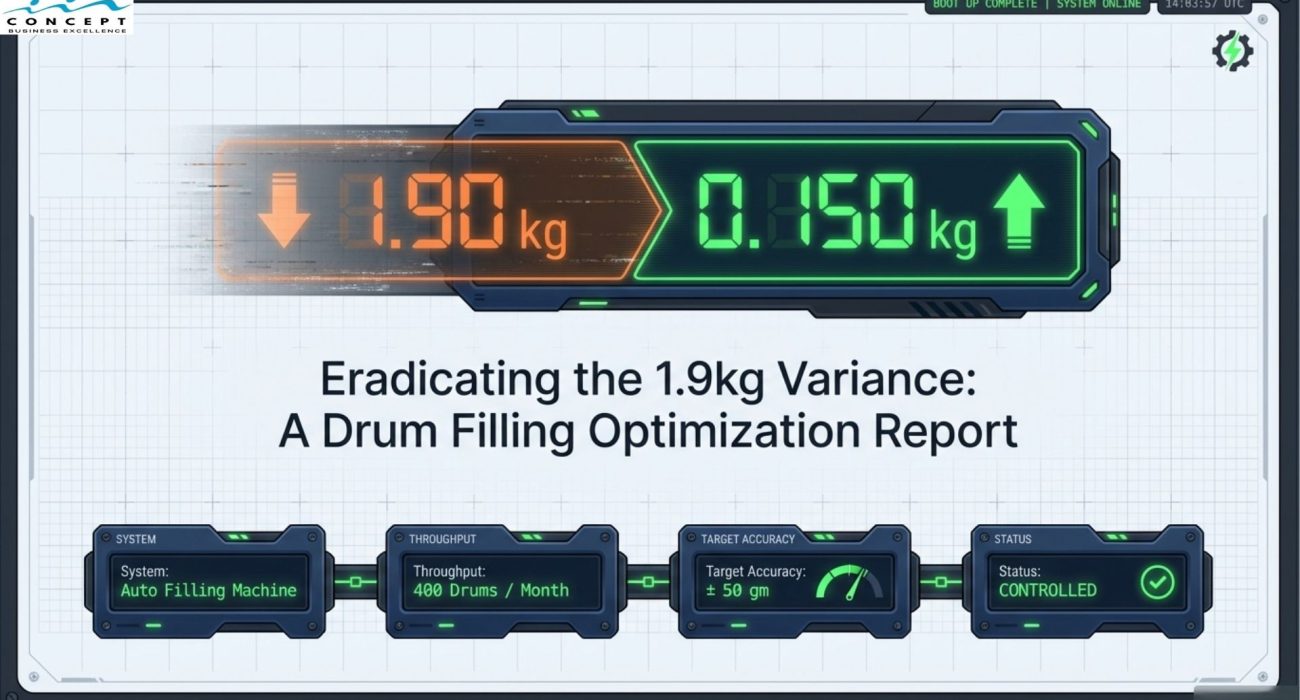
In process industries where liquid products are filled into drums, even minor variations in fill quantity can lead to significant financial losses, compliance risks, and customer dissatisfaction. A manufacturing unit faced persistent challenges in maintaining accurate drum filling levels, leading to overfilling, material wastage, and inconsistent output quality.
2. Problem Statement
The organization was experiencing the following:
- High variation in drum filling quantity
- Frequent overfilling resulting in product giveaway
- Occasional underfilling leading to customer complaints
- Lack of process control and repeatability
This directly impacted:
- Profit margins
- Process efficiency
- Brand reliability
3. Baseline Situation
Initial observations revealed:
- Significant deviation from target fill weight
- No standardized control mechanism
- Dependence on manual adjustments
- Process instability across batches
4. Root Cause Analysis
A structured Root Cause Analysis (RCA) was conducted to identify key contributors.
Key findings included:
- Inconsistent flow rate during filling
- Lack of calibration in measurement systems
- Operator dependency and manual intervention
- Equipment variability and absence of standard settings
The problem was not just operational—it was systemic.
5. Improvement Approach
A data-driven methodology was implemented using a combination of:
- Process analysis
- Standardization of parameters
- Calibration of equipment
- Reduction of human dependency
- Controlled experimentation (where applicable)
Focus was placed on stabilizing the process first before optimizing it.
6. Solution Implementation
Key actions included:
- Establishing optimal filling parameters
- Introducing control mechanisms for flow consistency
- Standard operating procedures (SOPs) for operators
- Equipment calibration and validation
- Monitoring system for real-time variation tracking
7. Results Achieved
Post-implementation, the process showed significant improvement:
- Reduction in filling variation
- Elimination/reduction of overfilling losses
- Improved consistency across batches
- Increased process reliability
Business Impact:
- Cost savings due to reduced product giveaway
- Improved customer satisfaction
- Better process control and predictability
8. Key Takeaways
- Small process variations can lead to large financial impact
- Manual processes limit consistency and scalability
- Data-driven decision-making is critical in operations
- Sustainable improvement requires system-level thinking
9. Conclusion
This case demonstrates that precision in seemingly simple operations like drum filling can unlock significant value when approached systematically. Organizations that invest in structured problem-solving and process control gain a competitive advantage through efficiency, quality, and cost optimization.