

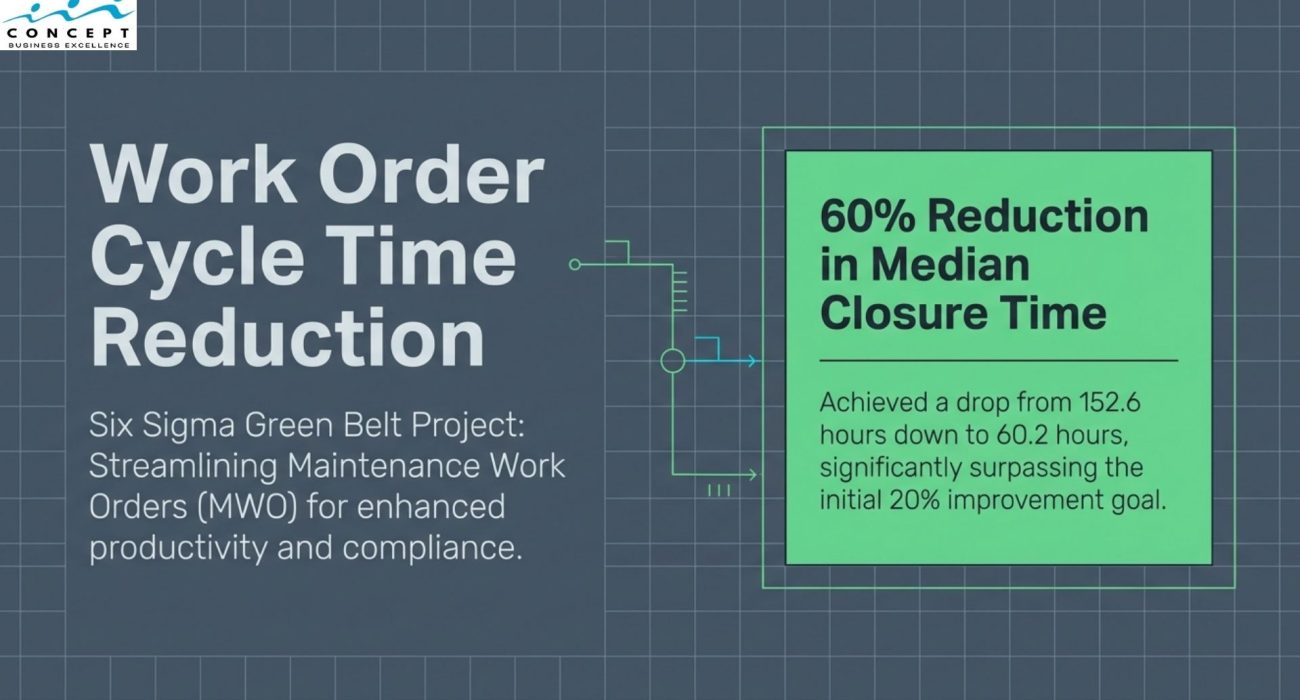
A manufacturing organization was facing prolonged cycle times in its MWO (Manufacturing Work Order) process, leading to delayed deliveries, increased work-in-progress (WIP), and reduced operational efficiency. The lack of process standardization and visibility across stages further amplified inefficiencies.
Challenge
- High MWO cycle time impacting delivery commitments
- Excess WIP inventory and bottlenecks across stages
- Limited process visibility and coordination between teams
- Inefficient handoffs and non-value-added activities
Approach
A structured improvement initiative was launched using Lean Six Sigma principles:
- Process Mapping: End-to-end value stream mapping to identify delays and waste
- Root Cause Analysis: Identification of bottlenecks, rework loops, and idle times
- Standardization: Streamlining workflows and defining clear process steps
- Load Balancing: Optimizing manpower and machine utilization
- Visual Management: Improved tracking and transparency of MWO status
Implementation
Key interventions included:
- Elimination of non-value-added activities
- Parallel processing in critical stages
- Improved scheduling and coordination
- Introduction of standardized work practices
- Real-time monitoring of cycle time metrics
Results
- Significant reduction in MWO cycle time
- Improved on-time delivery performance
- Reduction in WIP inventory
- Enhanced productivity and process transparency
- Better cross-functional alignment
Conclusion
By leveraging structured problem-solving and Lean methodologies, the organization successfully transformed its MWO process into a more efficient, predictable, and high-performing system. This initiative not only improved operational metrics but also strengthened overall business competitiveness.